6.0 Overview
Figure 6.0-1 shows an architectural approach for an Interworking Proxy Entity (IPE), which is implemented as an MCP server, positioned between a oneM2M CSE and an AI agent. The interworking enables AI agents to receive data from a oneM2M CSE and/or to provide data to it.
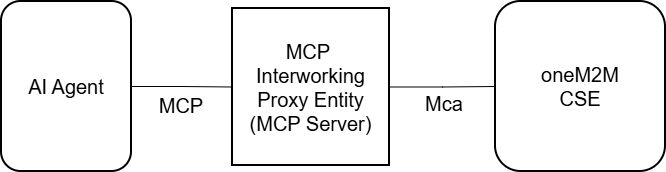
Figure 6.0-1: IPE architecture overview
An MCP server-based Interworking Proxy Entity can provide different levels of abstraction of the CSE to the agent. This means the AI agent needs to have varying degrees of knowledge about oneM2M and the CSE. The following examples illustrate three exemplary levels of agent knowledge about oneM2M:
-
The IPE hides all oneM2M functionalities:
The agent does not even need to know that oneM2M is involved behind the MCP server. This might be a solution for verticals, for agentic AI applications addressing certain specialized tasks. The agent might call a tool, for example, retrieving weather data from the IPE that is actually copied from the latest
<contentInstance>resource from the CSE. The IPE hides all oneM2M details and complexities, but the agent has no possibility of directly controlling oneM2M features, like for example setting 'labels'. -
The IPE allows for basic oneM2M functionalities:
The agent needs basic knowledge about major oneM2M concepts and/or data structures in a CSE. For example, the AI agent is able to read the latest
<contentInstance>resources from a dedicated<container>resource or it is able to create or delete<container>resources.This solution is feasible when the agentic AI application needs more flexibility in data management. For example, during runtime it might be necessary to extend the data model because new categories of data emerge. So the agent might need to reorganize the data and create new containers. Still, not all oneM2M functionalities need to be covered by the IPE to minimize complexity. Given the fact that every description of available tools in the MCP server is part of the context window, it makes sense to minimize the number of tools. Especially smaller language models could be overwhelmed by too much context, leading to a degradation of accuracy and resulting in errors during tool execution.
-
The IPE allows (nearly) full control of oneM2M functionalities:
The agent might be a oneM2M expert and is able to manage a CSE and conduct administrative tasks. For example, access policies or subscriptions could be configured for certain data. This might be a solution when an agentic AI application should be used instead of a configuration UI for the CSE.
An IPE allowing nearly full control of a CSE needs a lot of different tools to call. Since language models are not very reliable in choosing one out of many different tools with various parameters, it is recommended to implement this kind of agents as neuro-symbolic systems, where tool calls are conducted by a deterministic software part of the agent. This is especially true for huge software implementations needing many (e.g., more than 20) different tools to fulfill their tasks. Countermeasures to minimize context usage in MCP and increase reliability in tool calling will be discussed in the next section.