5.1 Basic concepts of Ontology-based Interworking
5.1.1 Ontology-based Interworking vs. specific interworking
oneM2M supports interworking with several specific non-oneM2M solutions. Examples are: LWM2M Interworking (oneM2M TS-0014 [5]) or OIC Interworking (oneM2M TS-0024 [6]). While these examples refer to specific technologies oneM2M also allows to specify only data models - e.g. in oneM2M TS-0023: "Home Appliances Information Model and Mapping" [4] - which does not assume that a specific technology is used. The data model in oneM2M TS-0023 could e.g. be implemented with 'native' oneM2M entities like ASNs, ADNs and MNs or it could just as well be implemented in a non-oneM2M solution that is interworked with oneM2M via an Interworking Proxy Application Entity (IPE).
Ontology-based Interworking is taking an approach similar to oneM2M TS-0023, however in this case the data model is not specified but can flexibly be provided in form of an ontology. That ontology needs to be formally described (e.g. in OWL format).
Ontology-based Interworking can be used in cases where oneM2M does not provide a standardized datamodel but still interworking is desired. Such a situation may arise if e.g. a company wants to publish their proprietary datamodel for interworking purposes but does not wish to reveal their proprietary technology (radio technology, communication protocol) for data transmission.
For Ontology-based Interworking the ontology that describes the data model of the interworked technology needs to be provided in the oneM2M solution. This ontology enables the IPE to create specific resourcetypes (specializations of <flexContainer>), through dynamically created XSDs that are derived from the ontology.
From these resourcetypes oneM2M resources are created by the IPE for communication of oneM2M communicating entities with the IPE.
As with any other form of interworking, the IPE provides the translation of data in these resources into/from the external technology.
5.1.2 Use of ontologies for Ontology-based Interworking with Area Networks
Interworking with Area Networks is accomplished in oneM2M through functionality provided by Interworking Proxy Entities (IPE).
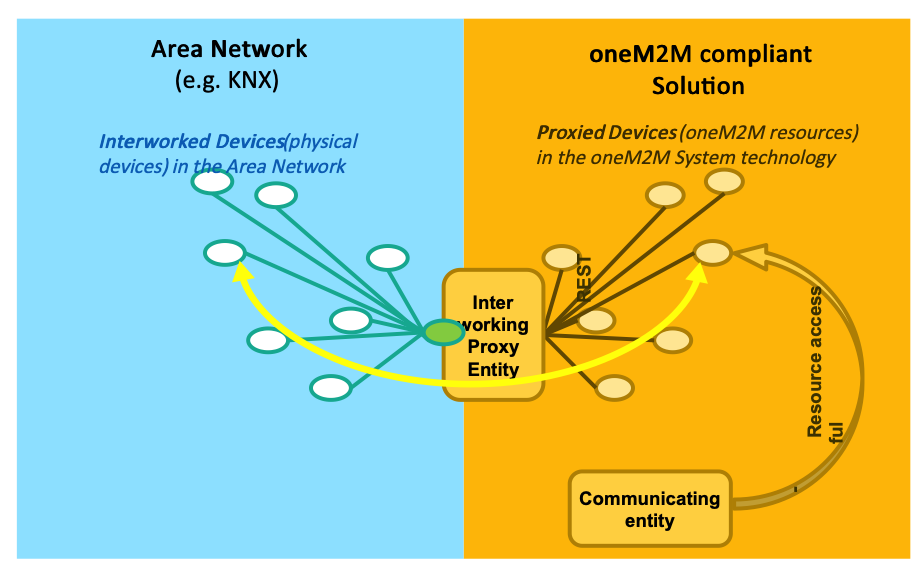
Figure 5.1.2-1: Interworking
The IPE creates "proxied" devices as oneM2M Resources (e.g. AEs) in the oneM2M Solution that can be accessed by communicating entities (e.g. oneM2M Applications) in the usual way.
To accomplish the creation of proxied devices the IPE uses an ontology that describes the Device Information Model of the interworked Area Network and its entities (device types, their operations, etc.).
For example, in figure 5.1.2-1, an ontology that describes a KNX Area Network and its entities would be needed.
To achieve the flexibility for the IPE to create proxied devices for many different types of Area Networks each ontology that describes a specific Device Information Model needs to be derived from the Base Ontology that is specified in [3]. This allows to specify a common scheme of mapping the classes of the ontology that describes the Device Information Model into oneM2M resources (see clause 7).
E.g. the OWL representation of an ontology that describes the Device Information Model of an Area Network of type "KNX" needs to:
- a) contain an 'include' statement which includes Base Ontology;
- b) the Class of "KNX Nodes" needs to be a subclass of the "Device" Class of oneM2M's Base Ontology;
- c) the Class of "KNX Communication Objects" needs to be a subclass of the "Service" Class of the Base Ontology;
- d) etc.
Note
For the purpose of Ontology-based Interworking with Area Networks the Base Ontology is only used to describe type information and not for describing instances of these types. E.g. the Base Ontology describes the type "Device", but does not contain information about a specific device.The Base Ontology therefore only contains Classes and Properties but not instances. That principle needs to be followed by the ontology that describes the Device Information Model.