5.2 Using Ontology-based Interworking with Device Abstraction
5.2.1 General description
As explained in clause 5.1 it is the task of an IPE to interact via the Area Network with the Interworked Devices and to provide oneM2M resources (Proxied Devices) to the communicating entities for communication with the Interworked Devices. However these Proxied Devices still exhibit the native data model - the Device Information Model of the external technology of the device - and a communicating entity needs to know that native Device Information Model (e.g. ZigBee, KNX... information model).
Device abstraction relieves a communicating entity that wants to communicate with an Interworked Device (e.g. a ZigBee device) from the need to know the native Device Information Model of that Interworked Device.
Additionally to providing interworking, the IPE may translate between the - technology specific - native Device Information Model and an Abstract Information Model, that is based on of common functionalities abstracted from a set of Device Information Models. Such Abstract Information Models can be provided by industry associations of a specific industry sector.
An example of an Abstract Information Model, which is specified in oneM2M is the Home Appliance Information Model (HAIM), specified in oneM2M TS-0023 [4].
As in the case of a native Device Information Model that is used by the IPE also an Abstract Information Model can be described by an ontology and that ontology needs to be derived from the Base Ontology.
5.2.2 An example, involving ZigBee, HAIM and SAREF
Figure 5.2.2-1 illustrates this situation for a light switch. In the example the physical implementation is a ZigBee device implementing a ZigBee Service "On/Off Cluster". An IPE for ZigBee creates the interworking towards the ZigBee network.
To enable abstraction, this device is abstracted as oneM2M device according to the Home Appliance Information Model (HAIM). In HAIM the corresponding Service is a "binary Switch".
Both types of Services expose a Function "On Off Function" which is e.g. described in the SAREF ontology.
To turn the switch on SAREF defines an "On Command".
The corresponding Service in HAIM is executed by setting an Input Datapoint called "powerState" to the binary value "TRUE".
In Zigbee an operation (ZigBee command) needs to be invoked in the On/Off Cluster with an input parameter (ZigBee Command ID) equal to 0.
A VariableConversion can been specified in the ontology of the ZigBee Device Information Model that contains the rules how to convert a value of InputDataPoint "powerState" into a value of OperationInput "ZigBee Command ID".
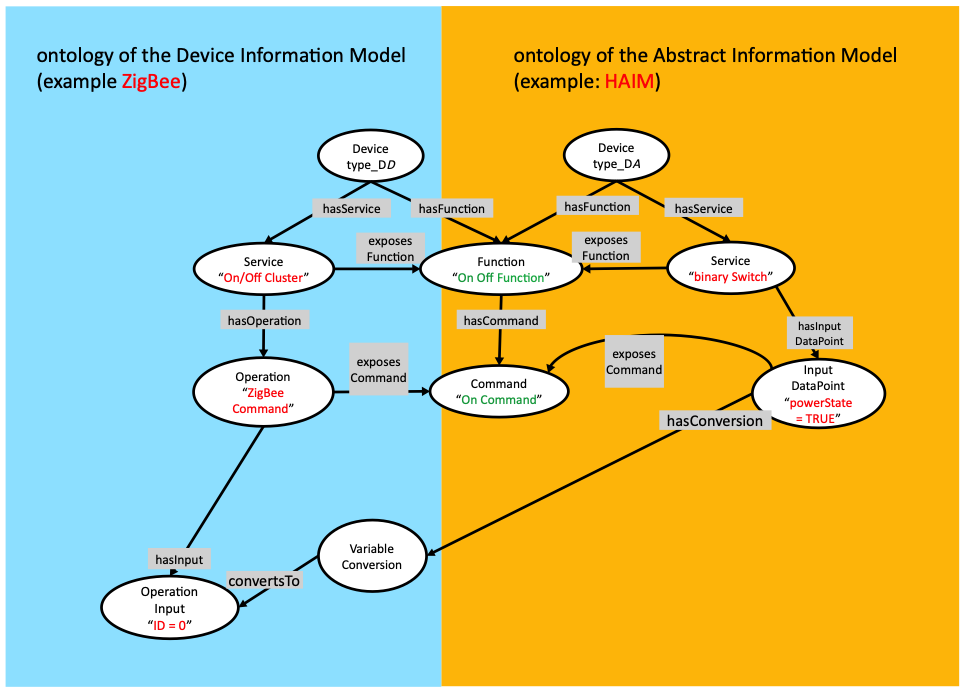
Figure 5.2.2-1: Ontologies relations