5.1 Introduction
This document introduces a baseline architecture for supporting 3GPP interworking and 3GPP Cellular Internet of Things (CioT) features such as IP and non-IP data Control Plane Data Delivery. It describes how the oneM2M system may leverage the IoT related features and services that 3GPP added in releases 10 through 15. Features and services may be accessed by an ADN-AE, MN-CSE, or an ASN-CSE that is hosted on a UE and an IN-CSE that is able to access services that are exposed by a MNO.
Figure 5.1-1 shows, at a high level, how 3GPP interfaces with external entities. A more detailed picture can be found in 3GPP TS 23.682 [2].
The 3GPP Trust Domain provides three interfaces to SCS for MTC: i) IP based interface at SGi reference point, ii) RESTful API interface at T8 reference point, iii) Diameter based interface at Tsp reference point. The Service Capability Server (SCS) is a 3GPP term that refers to an entity which connects to the 3GPP Trust Domain to communicate with UEs used for Machine Type Communication (MTC).
The SCS offers services to MTC Applications that are hosted on the UE or in an Application Server (AS). The SCS connects to the underlying 3GPP network as follows:
-
via the Sgi interface for IP based data plane communication between the SCS and 3GPP Trust Domain for MTC.
-
via the MTC Interworking Function (MTC-IWF) through the Tsp interface which is based on Diameter protocol as defined in 3GPP TS 29.368[8]. In this case, SCS shall support the Diameter protocol.
-
via Service Capability Exposure Function (SCEF) through the T8 interface which is based on a RESTful API as defined in 3GPP TS 29.122 [4]. In this case, the SCS shall support the HTTP protocol.
MTC Applications on the UE interact with the underlying 3GPP network via 3 different methods. MTC Applications may use the underlying 3GPP network to send IP packets to and from the SCS and/or other MTC Applications. MT SMS messages (i.e. device triggers) may be received by MTC Applications that are hosted on the UE and MTC Applications may use SMS messages to send data to the SCS and/or other MTC Applications. Also, NAS messaging may be used to send and receive non-IP data, send and receive IP data, configure power savings mode, configure extended idle mode DRX, configure low priority indicators, etc.
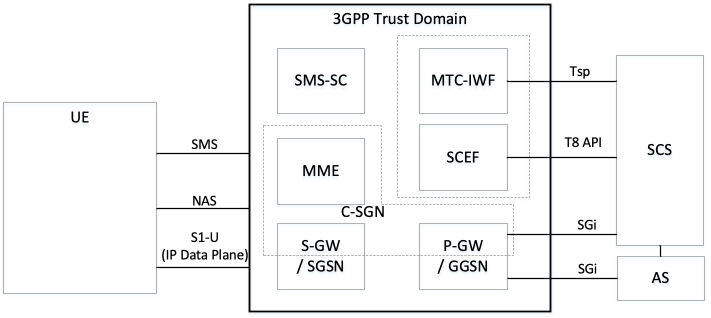
Figure 5.1-1: 3GPP IoT Related Interfaces